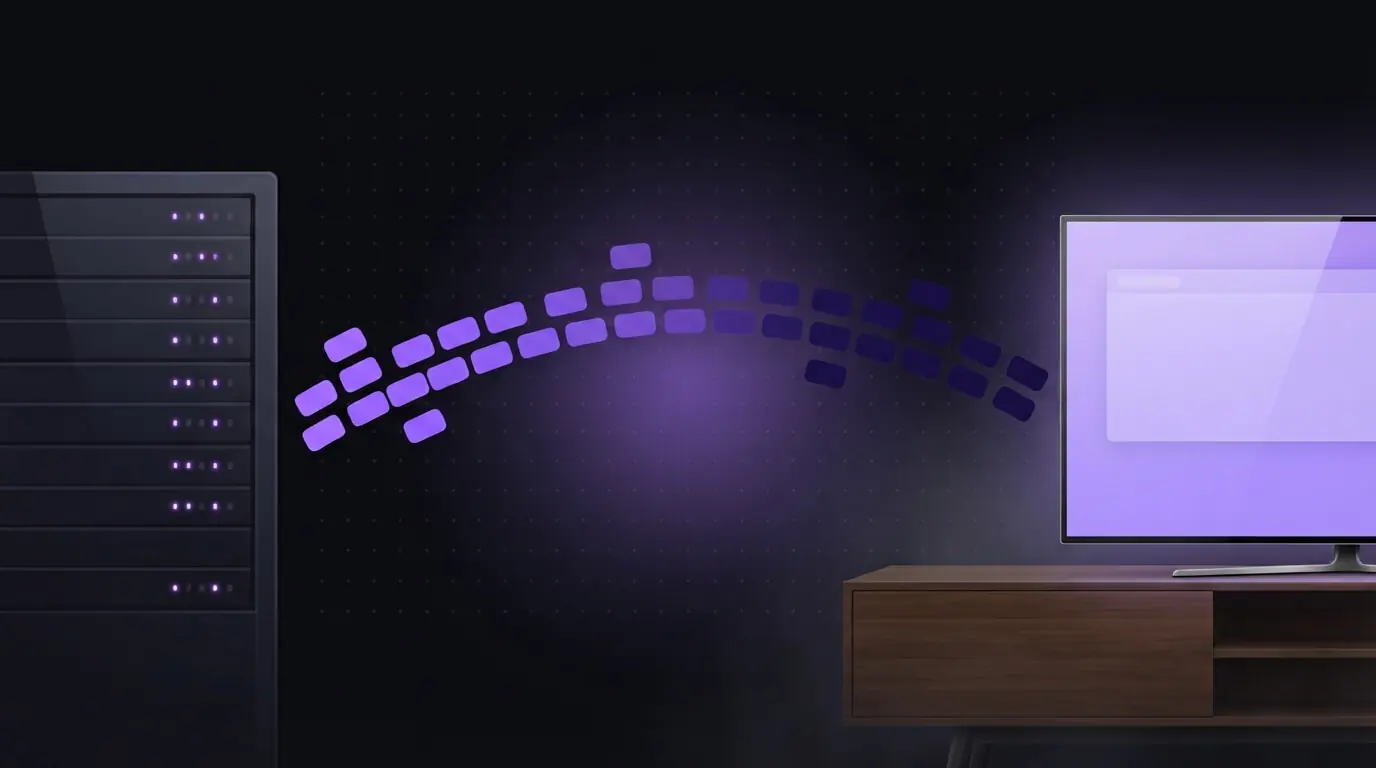
Internet Protocol Television, or IPTV, is television sent as data down an internet
connection rather than as a broadcast signal from an aerial, a dish or a cable.
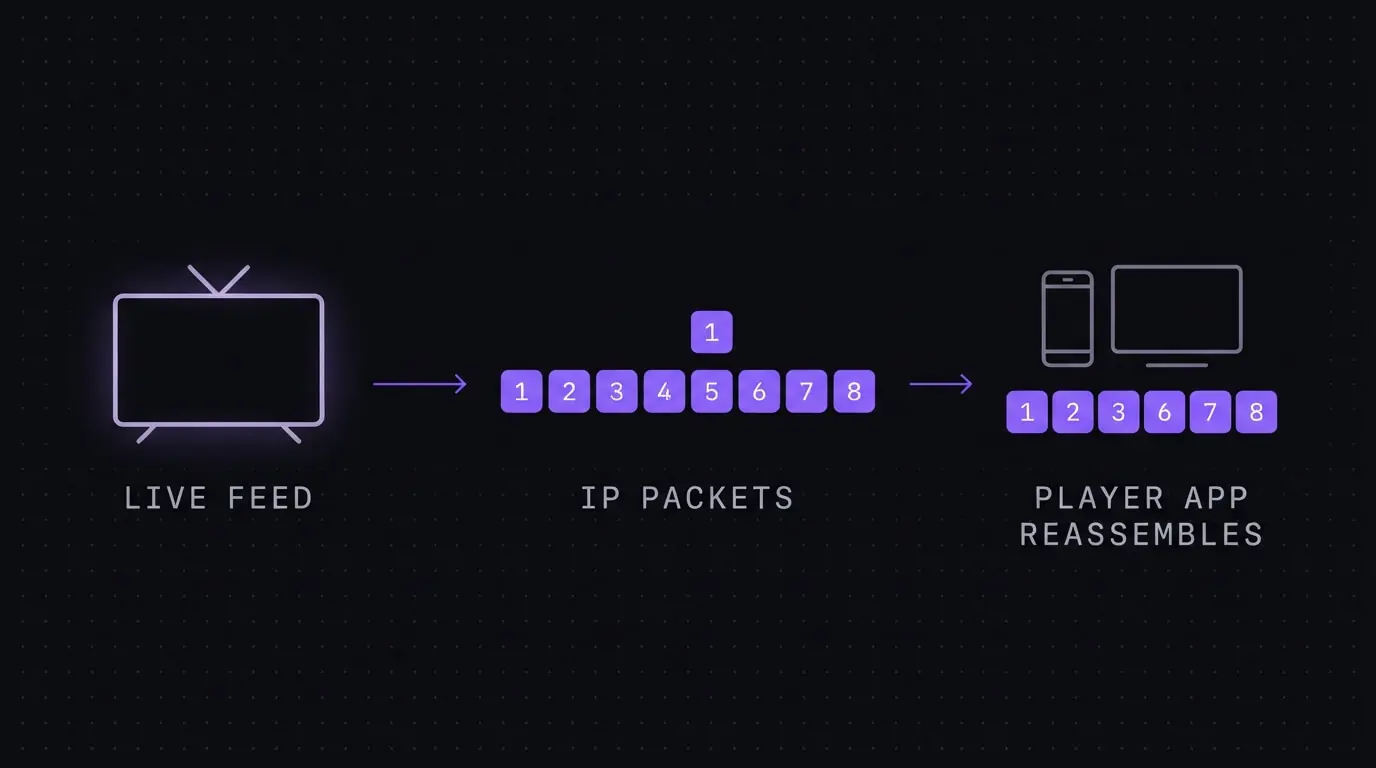
The programme is compressed, cut into numbered packets, pushed along your broadband line and
reassembled by a player on your television, phone or box. That is the entire concept. Everything
beyond it is plumbing, and the plumbing is what this guide walks through.
Internet Protocol Television is a fourteen-syllable name for something most people have been doing
for years without ever being told what it was called. Anyone who has opened a catch-up app on the
television has used IPTV. Nobody said so, because catch-up sounds like something you do on a wet
Tuesday and Internet Protocol Television sounds like something requiring a man in a van.
The acronym only began following people around once services started selling channel bundles this
way, so it now tends to arrive attached to a sales pitch. Which is a pity, because underneath the
pitch it is one of the more sensible ideas broadcasting has had. Here is what is genuinely going on.
What the "Internet Protocol" bit actually means
Internet Protocol is the addressing scheme that moves data around any network. It is not specific
to television and it is not new. It is the same mechanism delivering this page to
you right now.
The one feature that matters here is packet switching. Data is broken into small
numbered pieces, each stamped with a destination, each free to take whichever route across the
network happens to be available at that instant. They can arrive out of order, along different
paths, at slightly different moments. The receiving end reassembles them in sequence
using the numbers.
Broadcast television could never work that way. An aerial signal is one continuous stream going out
to everybody simultaneously, and if you were not tuned in as it passed, it was gone for good.
Cutting television into addressed packets is what made pausing, rewinding and starting a
programme three days late possible. See
the technical overview of IPTV
if you want the full standards history.
How a channel gets from a broadcaster to your telly
Five stages. The interesting one is the fourth.
1
The headend takes the feed
Every channel begins as a signal landing at an operator central facility, the headend in industry language. Satellite feeds, fibre feeds, on-demand libraries sitting on disk. None of it is internet traffic yet. This is the unglamorous end of the process and nobody markets it, because a building full of racks does not photograph well.
2
Encoders chop it into packets
The feed is compressed with a codec, usually H.264 or H.265 these days, and sliced into small numbered pieces called packets. Each carries a fragment of picture, a fragment of sound and an address. The numbering is the entire trick: it lets the fragments travel independently and still be reassembled in the correct order at the far end.
3
Servers hold it, ready to send
The packets sit on servers waiting to be requested. A live channel is being written and dispatched continuously; an on-demand title simply waits until somebody presses play. Capacity is decided here, and it is precisely why a service can look immaculate at four in the morning and come apart at ten past three on a Saturday.
4
Your line carries it, badly or well
The packets cross the public internet to your house, through the ISP, into your router, and over whatever the last few metres happen to be. This is the stage that fails. Not the headend, not the codec, not the servers. The twenty feet between the router and the television is where most of the trouble in this entire chain actually lives.
5
The player app puts it back together
A player on the television, stick or box gathers the packets, reorders them, decodes them, and holds a few seconds in reserve so one late arrival does not freeze the picture. When people say a stream is buffering, what they mean is that reserve ran out. Nothing is broken. It simply ran out of runway.
Unicast, multicast, and why one channel can cost more than another
There are two ways to send those packets, and the distinction explains a good deal of otherwise
baffling behaviour.
Unicast sends a private copy to each viewer. Ten thousand people watching means
ten thousand separate streams leaving the servers. It is simple, it survives the public internet,
and it is how essentially all on-demand viewing happens. You started that film
at 9.04pm and nobody else did.
Multicast
pushes one copy into the network and lets the network duplicate it only where the paths diverge.
Ten thousand viewers can share one stream for most of the journey. That is dramatically more
efficient for live television, and it is exactly why traditional telecoms operators built their
IPTV on managed networks they controlled end to end.
The difficulty is that multicast does not travel well across the open internet, so most consumer
services deliver live channels by unicast, meaning every additional viewer is a genuine cost,
which is why unlimited connections is a warning rather than a feature. Bandwidth
is finite and somebody is always paying for it. Our default is one concurrent connection, and
additional ones are arranged on WhatsApp rather than promised on a homepage.
IPTV, streaming and cable: where the lines actually fall
This is the most-asked question on the subject and most answers are neater than the truth deserves.
IPTV and what the industry calls over-the-top streaming rest on the same underlying technology.
The distinction is the network, not the picture.
Delivery
Travels over
Who controls quality
Needs a dish or aerial
Classic IPTV
A managed network the operator runs
The operator, end to end
No
Over-the-top streaming
The public internet
Shared, with no single owner of the whole path
No
Satellite or cable
A broadcast signal or coax
The broadcaster
Yes
In practice nearly all consumer IPTV in Britain now crosses the public internet, so the textbook
distinction has largely dissolved. Read IPTV as a description of how the picture arrives, not as a
guarantee about the quality of the road it travelled along.
The three types, and why every decent service has all three
Live. A channel broadcasting in real time. Packets are being created as you watch, so there is no rewinding past the moment you joined unless the operator is recording on your behalf
Time-shifted. Catch-up: something that already aired, held on a server for a few days so it can be watched late. This is the category almost everybody has used without knowing its name
On demand. A library simply sitting there. Films, box sets, anything with no broadcast time attached to it whatsoever
A service carrying live channels alone and describing itself as complete is missing two thirds of
what the technology permits. Ours runs 50,000+ live channels alongside 200,000+ on-demand films and
box sets, which is comfortably more than any household will finish and roughly
49,000 channels more than anyone opens.
The speed you need, and the number that actually matters
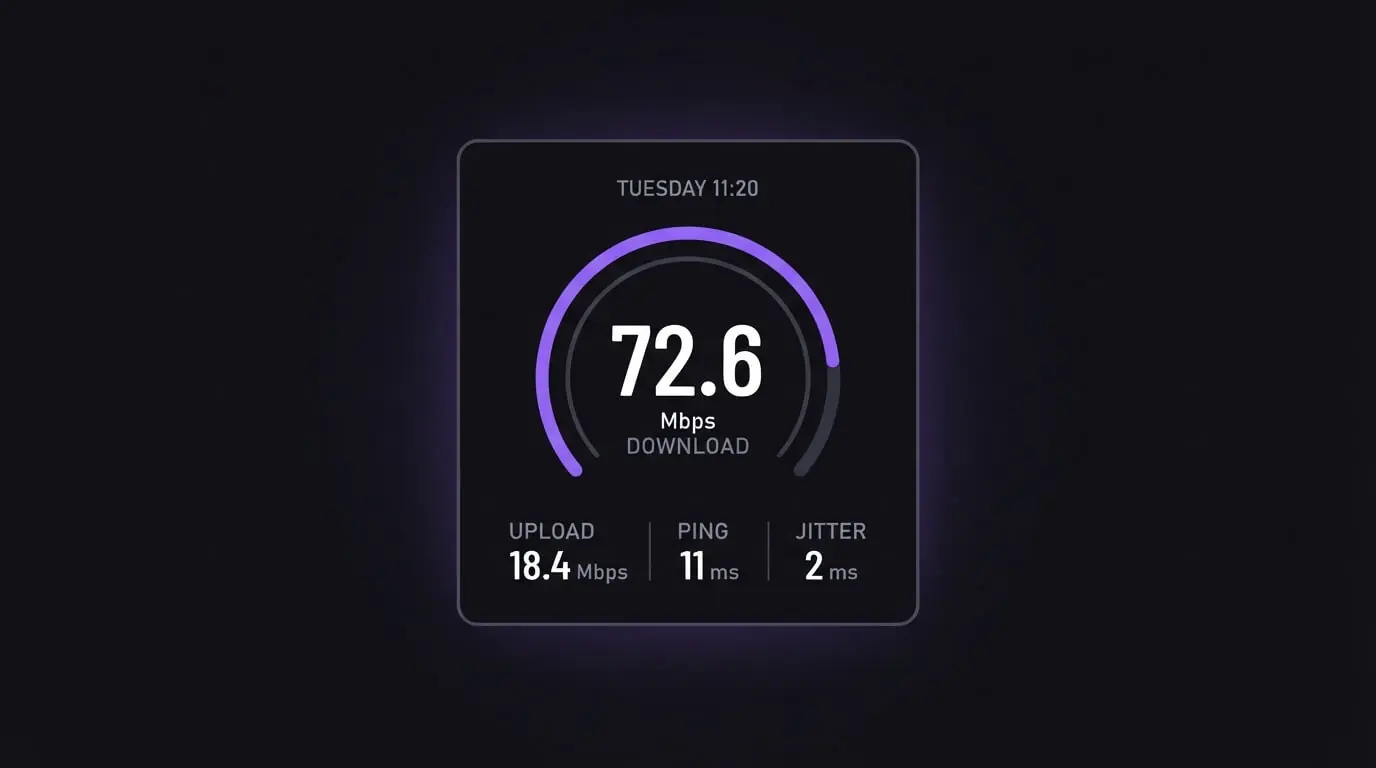
Fifteen Mbps is the floor for one reliable HD stream. Around 25 Mbps for 4K, and
more again for every additional simultaneous stream. Those are the only figures in this section
worth remembering, and nearly every British line clears them on paper.
On paper is doing real work in that sentence. Test at eight on a Saturday evening rather than
eleven on a Tuesday morning. Your street shares capacity with every other street, and the number
that decides whether your evening works is the peak one, not the one printed on the bill.
Ofcom
publishes UK home broadband performance data if you want to see how far real speeds drift
from advertised ones.
A customer messaged at nine on a Saturday evening to say the stream had died completely. The line
tested at 6 Mbps, on the 2.4 GHz band, three rooms away from the router, against a minimum of 15.
Moving the stick to 5 GHz and restarting the router fixed it inside five minutes. The service had
never dropped at any point. That is stage four in the list above, and it is where this goes wrong far
more often than anywhere else in the chain.
What you watch it on, and the thing quietly ruining it
Set-top boxes stopped being necessary some time ago. Smart TVs, streaming sticks, Android boxes,
phones, tablets, laptops, MAG boxes, Apple TV, Nvidia Shield, Enigma2 receivers and Formuler boxes
all decode the identical packets. A dedicated box handles channel guides more gracefully; a stick
is cheaper and already in most houses. Either is fine. Our
guide to IPTV boxes covers what is worth buying.
The device is rarely the culprit. The router your ISP posted you is the weak point in most
British homes. It was built to a price, it usually sits in the hallway behind a mirror, and
it has been powered on continuously for about three years. Replacing it improves playback more than
any other single change, and it beats upgrading the package outright, because a faster line into a
poor router is still a poor router.
After that, in descending order of usefulness: run an Ethernet cable, move to the 5 GHz band,
restart the router rather than the box, and use the small HDMI extender that came in the stick
packaging if the television is wall-mounted. (Everybody throws that extender away.
I have thrown away three.)
What all this means if you just want the telly on
Every other explainer on this topic is written for a network engineer or a hotel procurement
manager. This is the version for somebody standing in a living room in Britain
holding a remote.
You are already using it. Catch-up apps are IPTV. The technology is neither exotic nor a workaround
The line decides the picture, not the badge on the service. Two providers carrying identical channel lists will look different in your house, entirely because of stages four and five
Buffering is a bandwidth symptom rather than a fault code. Check what the connection is doing at the moment it happens before blaming anybody
No dish, no aerial, no engineer appointment. That is the real practical difference, and it is why a service can be switched on the same afternoon it is bought
One connection means one stream. Two people wanting different things at once need a second, and any provider suggesting otherwise is hoping nobody checks
If the money side interests you more than the mechanics, that lives in the
IPTV UK guide, and the licensing question has its own
plain-English explainer.
When Internet Protocol Television is the wrong answer
Nobody writing a glossary entry is going to tell you this, so here it is.
Peak-time speed under 15 Mbps. Repair the line first. No service, box or app makes up for a connection that cannot carry the packets, and saying so on WhatsApp beats banking the payment
You only watch the terrestrial highlights. Those are free already and built into the television already
You want certainty at kickoff and cannot cable the television. Wifi through two brick walls at peak is a gamble, and a cup final is a poor moment to run the experiment
You watch one thing a month. The arithmetic does not close. Go to the pub
Straight answers about Internet Protocol Television
What does IPTV stand for?
Internet Protocol Television. Internet Protocol is the addressing scheme that moves data across any network, and IPTV means nothing more than television delivered using it, rather than through an aerial, a dish or a coaxial cable.
How does Internet Protocol Television work?
The channel reaches an operator central facility, is compressed and cut into numbered packets, and is held on servers. Selecting it sends those packets across your broadband to a player app, which reorders and decodes them back into a picture. A few seconds are held in reserve to absorb anything arriving late.
What is the difference between IPTV and streaming?
They rest on the same technology, which makes the boundary blurrier than most write-ups admit. The textbook split is about the network: classic IPTV travels a managed network the operator controls from end to end, whereas over-the-top streaming crosses the public internet like everything else. Nearly all consumer IPTV in Britain today is the second kind.
What are the three types of IPTV?
Live, meaning a channel broadcasting in real time. Time-shifted, meaning catch-up: something that already aired and is being held for a few days. And video on demand, a library you can start at any moment. Most services carry all three simultaneously, and one carrying only the first is offering a third of what the technology allows.
Do I need a set-top box for IPTV?
Not for years now. A dedicated box handles decoding and guide rendering elegantly, but a smart TV app, a stick, a handset, a tablet or a laptop each do the same work. Two requirements only: the device decodes the codec in use, and it holds a stable connection while doing so.
What internet speed do I need for IPTV?
Fifteen Mbps is the floor for one reliable HD stream. Allow around 25 Mbps for 4K, and add more for every additional stream running at once. Measure it in the evening rather than mid-morning: your street shares capacity, and the evening figure is the only one that decides whether your Saturday works.
Is IPTV the same as a smart TV?
No. A smart TV is hardware with applications on it; IPTV is a method of delivery. The television is one of many devices capable of receiving it, in roughly the way a kettle is not the same thing as electricity.
Is Internet Protocol Television legal?
The technology is entirely legal and in daily use by broadcasters themselves. Legality attaches to licensing: a service is lawful where the content it carries is licensed from the rights holder, and unlawful where that content is redistributed without permission. The delivery mechanism is never the deciding factor.
The verdict
Internet Protocol Television is a delivery method rather than a product. Once you know it is simply
addressed packets crossing your broadband and being reassembled at the far end, most of the
marketing around it stops being mysterious and becomes checkable. Ask what the concurrency limit is.
Ask what happens at renewal. Then test the thing at peak time and believe the result.
If ours is worth a look, it is £19.99 for a month as a single payment, with seven days
money-back window and no card kept on file.
Message us on WhatsApp
and we reply in under two minutes during UK hours.
And if the picture still stalls after all of that, the protocol is not the problem. Internet
Protocol has been working quietly since 1974. What has not is the router in your hallway, behind the mirror,
nobody has turned off since the last general election.
Get the best IPTV UK subscription today
50,000+ channels, genuine 4K, live within minutes of paying. One, three, six or twelve months, same content on all four. Nothing renews, nothing is added at checkout, nothing is held back for a higher tier.